
CHINACOAT 2026 ran from 11 to 13 November at the Canton Fair Complex in Guangzhou. DECHEM exhibited at Booth 2.1E71, presenting its hydroxy functional acrylic monomer range together with the UV-curable resin line.
Across the three days the team spent most of its time in specification conversations rather than on brochures: hydroxyl value consistency, residual acrylic acid, inhibitor levels, moisture, and how each monomer behaves inside a specific resin system. Visitors came from coatings, adhesives, inks and UV formulating backgrounds, and several conversations started with a TDS in hand and a formulation problem to solve.
This page records what was shown at the booth, the questions that came up repeatedly, and the documents that can still be requested.
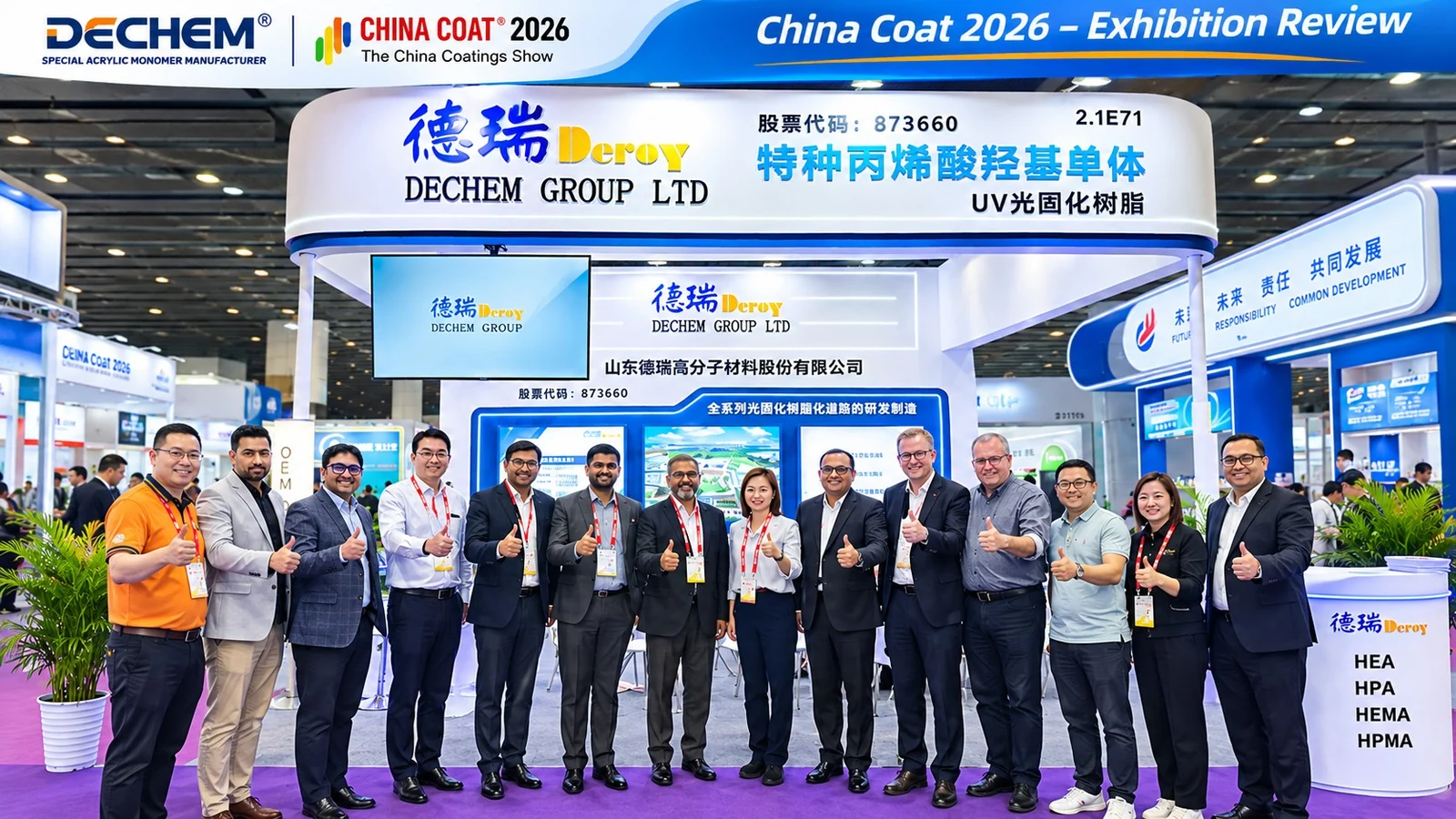
What we presented
Four hydroxy acrylate monomers formed the centre of the display, all produced at the Shandong manufacturing base and supplied with batch documentation:
- 2-HEA (2-hydroxyethyl acrylate, CAS 818-61-1) — the fastest-reacting of the four, used as a hydroxyl crosslinker in radiation-curable oligomers and in fast-cure industrial systems.
- HEMA (2-hydroxyethyl methacrylate, CAS 868-77-9) — chosen where film hardness and abrasion resistance matter: automotive clearcoats, optical polymers, hard UV coatings.
- 2-HPA (2-hydroxypropyl acrylate, CAS 25584-83-2) — the flexibility option, with low volatility and good chemical and weather resistance in 2K PU systems.
- HPMA (hydroxypropyl methacrylate, CAS 27813-02-1) — low shrinkage and good adhesion, typically specified for heat-cured acrylic enamels and substrates that need scratch resistance.
| Product | CAS No. | Typical purity | Where it is usually specified |
|---|---|---|---|
| 2-HEA | 818-61-1 | ≥ 99.5% | Radiation-curable oligomers, fast industrial cure |
| HEMA | 868-77-9 | ≥ 99.3% | Automotive clearcoats, optical polymers, hard UV films |
| 2-HPA | 25584-83-2 | ≥ 99.2% | 2K PU coatings, flexible industrial finishes |
| HPMA | 27813-02-1 | ≥ 99.4% | Heat-cured enamels, adhesion-critical systems |
Alongside the monomers, the UV/EB oligomer series was on display for industrial coatings, screen and flexo inks, and specialty adhesives — the same materials described in our pre-show technical note.
Technical exchange with formulators
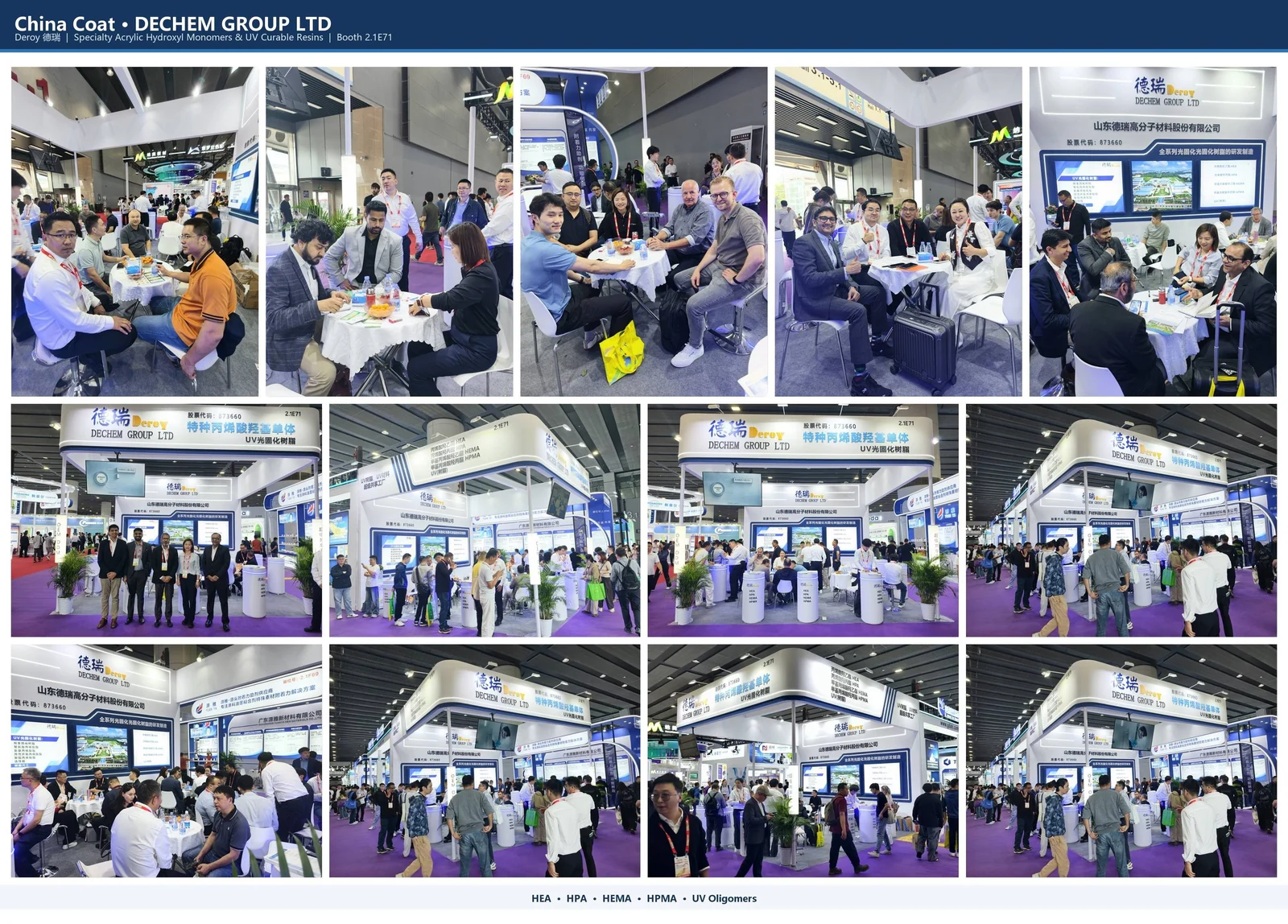
The booth worked as a technical counter for most of the show. Rather than collecting cards, the team walked through batch data with visitors and compared it against their incoming specifications. The collage below gives a sense of the traffic and the mix of meetings across the three days.
The questions that came up most
- Batch-to-batch consistency. Buyers wanted to see hydroxyl value and acid value across consecutive lots, not a single certificate. Our answer is to quote from the COA history of the specific grade, and to let the specification limits — not a marketing figure — drive the discussion.
- Residual monomer and odour. Formulators working on low-odour and low-VOC systems asked specifically about residual acrylic acid and moisture. Both are controlled parameters on our TDS, and both are reported per batch.
- Inhibitor level versus cure speed. MEHQ content is a trade-off: enough for storage stability, not so much that it interferes with curing. Several visitors compared our inhibitor range against the level their process actually tolerates.
- Handling and packaging. 200 kg drums and 1,000 kg IBCs were the two formats discussed most, together with drum return, decanting practice and cold-weather storage.
- Documentation for export. REACH readiness, SDS in the GHS format, and country-specific import paperwork came up in almost every second conversation.
Applications discussed
Most of the application questions fell into four groups:
- 2K polyurethane coatings — 2-HPA and HEMA for balanced flexibility and hardness; hydroxyl value matching against the isocyanate component.
- Industrial wood and plastic coatings — 2-HEA where cure speed drives line throughput.
- Adhesives and sealants — HEMA and HPMA for adhesion to difficult substrates and low shrinkage during cure.
- UV-curable inks and coatings — 2-HEA as a reactive diluent/crosslinker in radiation-curing systems.
Documents, samples and supply
Every shipment is accompanied by a batch-specific Certificate of Analysis, the Technical Data Sheet for the grade, and the current Safety Data Sheet in GHS format. Samples for laboratory or pilot trials can be arranged from stock, and lead time is confirmed per order rather than quoted as a fixed number.
International sales for these grades are handled by the export team at dechemchemicals.com; the manufacturing base, capacity and plant information are documented at dechemindustries.com.
Next step
If you were at the show and want to continue a specific conversation, or if you missed us, send the grade, application and destination port and we will come back with the matching TDS, a COA example and a sample arrangement.
- WhatsApp: +86 151 6553 8198
- Email: sales@acrylatemonomers.com